
Protecting your business starts with understanding what your insurance actually covers.
Running a business in Thailand means managing opportunities, people, assets, suppliers and operational risks. Whether you lead a local company, manage a regional subsidiary or oversee the Thai operations of an international group, insurance should be an integral part of your risk management strategy.
Yet having several insurance policies does not automatically mean that your business is adequately protected.
Coverage may be insufficient, exclusions may not match your activities, and important risks may sit between different policies. These issues are often overlooked until a claim occurs.
At A.SURE, we believe that effective business insurance starts with understanding how a company operates, where its exposures lie and what financial consequences an unexpected event could create.
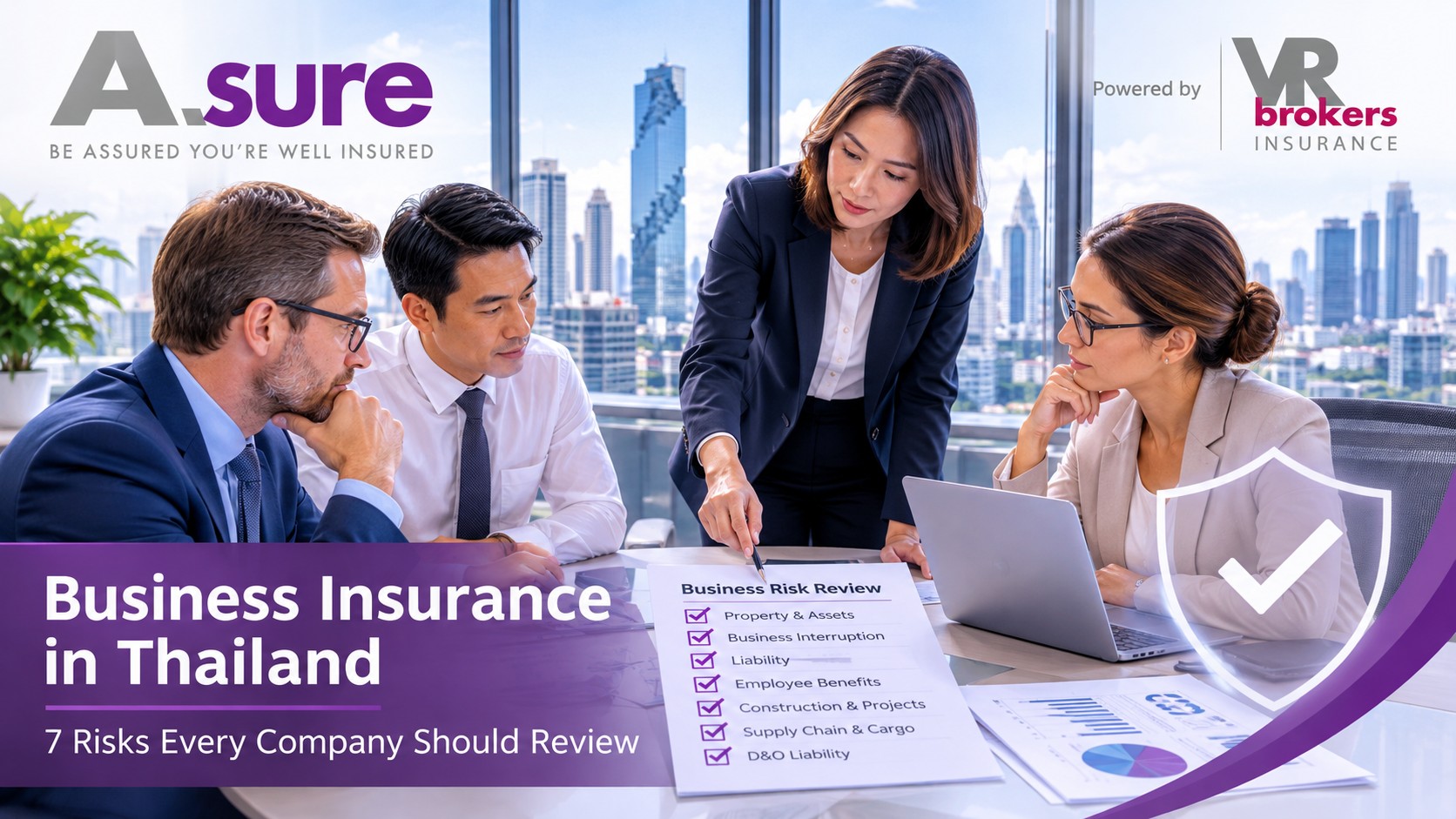
Here are seven areas that CFOs, HR directors and business owners should review when assessing their corporate insurance programme in Thailand.
1. Property insurance: Are your assets properly protected?
Your company’s buildings, machinery, equipment, stock, furniture and other physical assets may represent a substantial investment.
However, the value recorded in your accounts may not necessarily reflect the amount required to repair or replace those assets following a major loss.
A property insurance review should consider:
- Whether declared property values reflect current replacement costs.
- Whether machinery, equipment, inventory and tenant improvements are adequately included.
- Whether the insured premises and business activities are accurately described.
- Whether relevant risks, such as fire, water damage, storms or flooding, are covered under the policy.
- Which exclusions, deductibles, limits and special conditions apply.
Flood and natural catastrophe exposure deserves particular attention.
The protection available depends on the policy wording, insured location, selected extensions, sub-limits and applicable exclusions. Do not assume that every natural catastrophe is automatically covered.
For CFOs, the key question is straightforward: if a major physical loss occurred tomorrow, would the insurance proceeds realistically support the cost of recovery?
2. Business interruption: Could your company survive a shutdown?
Damage to property is only one part of a major incident. The financial consequences of being unable to operate can be equally significant.
Imagine a manufacturing facility, warehouse, hotel or office suffering insured physical damage. Even after the immediate damage has been assessed, the business may face reduced revenue, continuing fixed expenses, delayed deliveries and additional operating costs.
Business interruption insurance may help address certain financial losses following an insured event, subject to the policy’s terms and conditions.
Before relying on this protection, review:
- The events that can trigger cover.
- The method used to calculate the insured gross profit or other declared financial measure.
- The indemnity period and whether it reflects realistic recovery times.
- The treatment of additional costs incurred to maintain operations.
- Any waiting periods, exclusions, sub-limits or other restrictions.
Businesses should also consider their dependence on key suppliers, logistics providers and critical infrastructure. Damage at another company’s premises may disrupt your operations, but supplier-related losses are not necessarily covered by a standard business interruption policy.
A useful exercise is to model a prolonged interruption.
How long could your business continue paying salaries, rent, financing costs and other commitments if revenue suddenly fell?
The answer can help determine whether your existing limits and indemnity period remain appropriate.
3. Liability insurance: What if your business causes damage to others?
Companies can face claims arising from their operations, products, premises or professional activities.
The appropriate insurance depends on the nature of the business and the liabilities it may incur.
Consider three distinct areas:
Public liability: Potential claims involving third-party bodily injury or property damage connected with covered business activities.
Product liability: Potential claims relating to injury or damage allegedly caused by products supplied by your business, subject to the policy wording.
Professional indemnity: Potential claims arising from covered professional services, errors or omissions, where this type of protection is relevant to your activities.
These covers are not interchangeable. A company selling products, a construction contractor, a consulting firm and a property operator may have very different exposures.
Review the geographical scope of cover, the activities declared to insurers, the applicable limits, deductibles and exclusions, and whether contractual obligations create additional exposures.
If your business exports goods, serves overseas customers or operates across several jurisdictions, check whether the policy responds to the territories in which your products and services are actually used.
4. Employee health insurance: Does your benefits programme meet your needs?
For many companies, employee benefits are both a financial commitment and an important part of recruitment and retention.
A corporate health insurance programme should be assessed against the needs of the workforce, the company’s budget and the benefits it intends to provide.
HR directors and finance teams should review:
- Hospitalisation and outpatient benefits, where selected.
- Annual limits, sub-limits, deductibles and co-payments.
- Eligibility requirements and rules for dependants.
- Access to appropriate hospitals and medical providers.
- Renewal conditions and the way premiums may change.
- Claims administration and support for employees.
An international workforce may have different expectations from a predominantly local workforce. Employees travelling frequently or relocating between countries may also need a different approach to geographical coverage.
The cheapest premium is not necessarily the most cost-effective option if the benefits do not meet employees’ needs. Equally, a more expensive programme is not automatically better.
The objective is to find a sustainable balance between meaningful protection, employee expectations and the company’s total benefits budget.
HR and finance should ideally review the programme together, using claims experience and workforce needs where reliable data is available.
5. Construction, engineering and project risks: Are your contracts insured correctly?
Companies involved in construction, installation, renovation or engineering projects may face risks that differ substantially from those of a standard office-based business.
Depending on the project, relevant insurance arrangements may include contractors’ all risks, erection all risks, third-party liability, equipment cover, marine cargo and delay-in-start-up protection.
The correct structure depends on the contract, the parties involved, the project location and the allocation of responsibilities.
Before work begins, confirm:
- Who is responsible for arranging each required policy.
- Whether the insured parties and contractual responsibilities are correctly identified.
- Whether the construction or installation period is accurately declared.
- Whether third-party liability and surrounding property exposures are addressed.
- Whether transit, testing, commissioning and subsequent maintenance periods require specific treatment.
- Whether project delays create financial exposures that need separate consideration.
A contract requiring insurance does not, by itself, guarantee that the policy purchased provides the required protection.
The insurance programme should be reviewed against the actual contract wording and project timetable before work starts, rather than after an incident occurs.
6. Marine cargo and supply chain: Where does your responsibility begin and end?
Thailand’s role in regional manufacturing and international trade means that many businesses depend on the movement of goods across borders.
However, a commercial agreement, a freight contract and an insurance policy may allocate responsibilities differently.
Companies importing raw materials, exporting finished products or moving equipment should assess how goods are protected during transit.
Important questions include:
- Who is responsible for arranging cargo insurance under the sales contract?
- What goods, routes and modes of transport are declared?
- Are loading, unloading, temporary storage or transshipment addressed where relevant?
- What exclusions, deductibles and claims documentation requirements apply?
- Could a shipment delay disrupt production or customer commitments?
Incoterms® can help define certain responsibilities between buyers and sellers, but they do not automatically determine whether insurance exists or what a particular policy covers.
A cargo insurance review should therefore consider the commercial contract, the transport arrangements and the actual policy wording together.
Businesses with critical imported components should also assess whether alternative suppliers, additional stock or contingency arrangements are needed. Insurance is one part of a wider supply chain resilience strategy.
7. Directors and officers liability: Are your company’s decision-makers exposed?
Directors and senior executives make decisions that can have significant financial and operational consequences.
Depending on the circumstances and applicable law, claims or investigations may arise from allegations concerning management decisions, governance, disclosure or other acts connected with their responsibilities.
Directors and officers (D&O) liability insurance may provide protection for covered claims against insured individuals, subject to the policy terms, exclusions and applicable law.
When reviewing this cover, consider:
- Which individuals and entities are insured.
- The scope of covered claims and defence costs.
- The policy limit and any applicable sub-limits.
- Exclusions and circumstances that may restrict cover.
- The territorial and jurisdictional scope.
- How the policy responds to the company’s wider governance and risk management arrangements.
D&O insurance does not eliminate directors’ responsibilities or guarantee protection against every claim. It should be considered alongside appropriate governance, compliance and legal advice.
For international groups operating in Thailand, it is particularly important to understand how local operations, overseas parent companies and regional management responsibilities fit within the insurance structure.
How often should your business insurance be reviewed?
An annual renewal is a natural opportunity to review your insurance programme, but waiting until renewal may not be appropriate when your business changes significantly.
Consider requesting a review when you:
- Open a new site or relocate premises.
- Acquire machinery, equipment or another business.
- Launch a new product or service.
- Enter a new export market.
- Sign a major construction or supply contract.
- Expand your workforce or change your employee benefits.
- Experience significant changes in turnover, stock values or operational processes.
Keeping insurers informed of material changes, in accordance with your policy obligations, can be important to maintaining appropriate cover.
A structured review should examine not only individual policies but also how they work together, where exclusions overlap and where potential gaps remain.
Why work with an insurance broker?
Selecting insurance is not simply a matter of comparing premiums.
A professional broker can help a company identify its exposures, clarify its requirements, compare available insurance solutions and understand the practical implications of policy wording.
The appropriate process begins with the business itself: its assets, contracts, employees, suppliers, financial commitments and plans for growth.
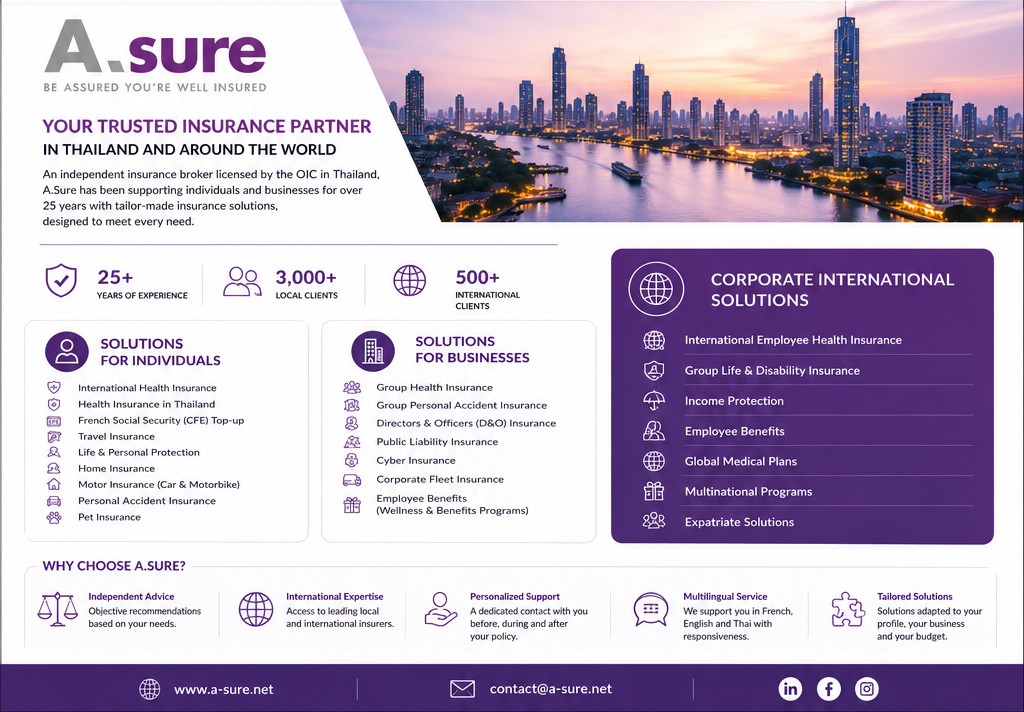
At A.SURE, we assist companies in assessing their insurance needs and exploring solutions across areas including property, business interruption, liability, construction and engineering, marine cargo, professional indemnity, directors and officers liability, and employee benefits.
Our objective is to help businesses make informed decisions about their insurance protection, based on their specific circumstances and the terms of the solutions available.
No insurance programme can remove every business risk. The aim is to understand those risks, determine which can be insured and make informed decisions about the remaining exposures.
Is your business insurance programme ready for the unexpected?
If you are a business owner, CFO, HR director or operations manager in Thailand, now is a good time to ask whether your existing insurance programme still reflects the way your company operates today.
A structured review can help identify areas that deserve further attention before a claim occurs.
Contact A.SURE to discuss an insurance review tailored to your business.
Visit www.a-sure.net or email contact@a-sure.net to discuss your company’s insurance requirements.
A.SURE is the insurance brokerage brand of VR Brokers Co., Ltd. Insurance availability, coverage and eligibility are subject to the terms, conditions, exclusions and underwriting requirements of the relevant insurer. This article is for general information only and does not constitute legal, financial or insurance advice for a specific situation.
0 Comments